
2027 · Supersport · Buyer's Guide
Ninja H2 (MY2027)
The Supercharged Street Missile
The Machine's Character
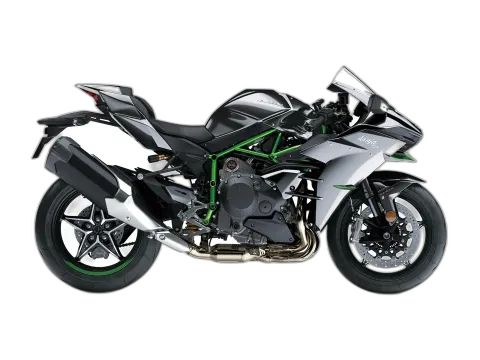
One thing sets this bike apart from everything else on the page: a supercharger. Kawasaki built it in-house with input from its gas turbine and aerospace divisions, and says it runs efficiently enough that it doesn't need an intercooler. The 998 cc inline-four makes 200 hp at 11,000 rpm and 100 lb-ft at 8,500 rpm, and it drives through a dog-ring six-speed. Kawasaki says it designed the steel trellis frame around it to handle the closed-course Ninja H2R. Its Aerospace Systems Company shaped the chin spoiler and winged mirror stays, which are claimed to press the front down at speed. That's engineering, not decoration. Pure Kawasaki!
So what's all that hardware for? On paper, it's built for stability at very high speed first and sharp cornering second. The bike weighs 525 lb (238 kg) wet, sits on a 57.3 in (1,455 mm) wheelbase and runs a 200/55-17 rear tire. All of that points to a machine made to stay planted when the speed gets big, and you can tune it through an adjustable KYB AOS-II fork and an Öhlins TTX36 shock. The IMU-based electronics cover ABS, traction control, ride modes and launch control. Cruise control and a quickshifter look after the miles in between. The solo seat with hip-support pads tells you who it's for: one rider who wants serious speed on the open road. A rare breed.
Hard Numbers
Spec sheets don't ride bikes, but they set the baseline.
Show full specs & equipment Hide specs & equipment
| Power | 200 hp (147 kW) @ 11,000 rpm |
|---|---|
| Torque | 100 lb-ft (135 Nm) @ 8,500 rpm |
| Displacement | 998 cc |
| Engine | Inline-four |
| Cooling | Liquid-cooled |
| Gearbox | 6-speed |
| Final drive | Chain |
| Fork | Upside-down (USD) |
| Front brake | 330 mm |
| Front tire | 120/70-17 |
| Rear tire | 200/55-17 |
| Wheelbase | 57.3 in (1455 mm) |
| Seat height | 32.5 in (825 mm) |
| Wet weight | 525 lb (238 kg) |
| Fuel capacity | 4.5 gal (17 L) |
Equipment check
Chassis
- Manually Adjustable Front Suspension KYB AOS-II Small bump complianceBottoming resistance Standard
- Manually Adjustable Rear Suspension Öhlins TTX36 Wider usable rangeDamping tuning to style Standard
Connectivity
- TFT Display Standard
- Smartphone Connectivity Standard
Drivetrain
- Quickshifter Standard
Safety
- ABS Standard
- Cornering ABS Standard
- Traction Control Standard
- Ride Modes Standard
- Launch Control Standard
Signature Tech
The named systems that set this bike apart — and what each one does for you.
Braking
- Brembo Hypure Caliper Standard
- Agile weight reduction
- Brake fade resistance
- Firm brake lever feel
- Stronger consistent braking
The Numbers Compared
Compare the technical specifications of the Kawasaki Ninja H2 with other bikes in its class.
Technical specs vs. the class average
Head-to-head: Kawasaki Ninja H2 vs. its rivals
Power
Torque
Displacement
Wet weight
Seat height