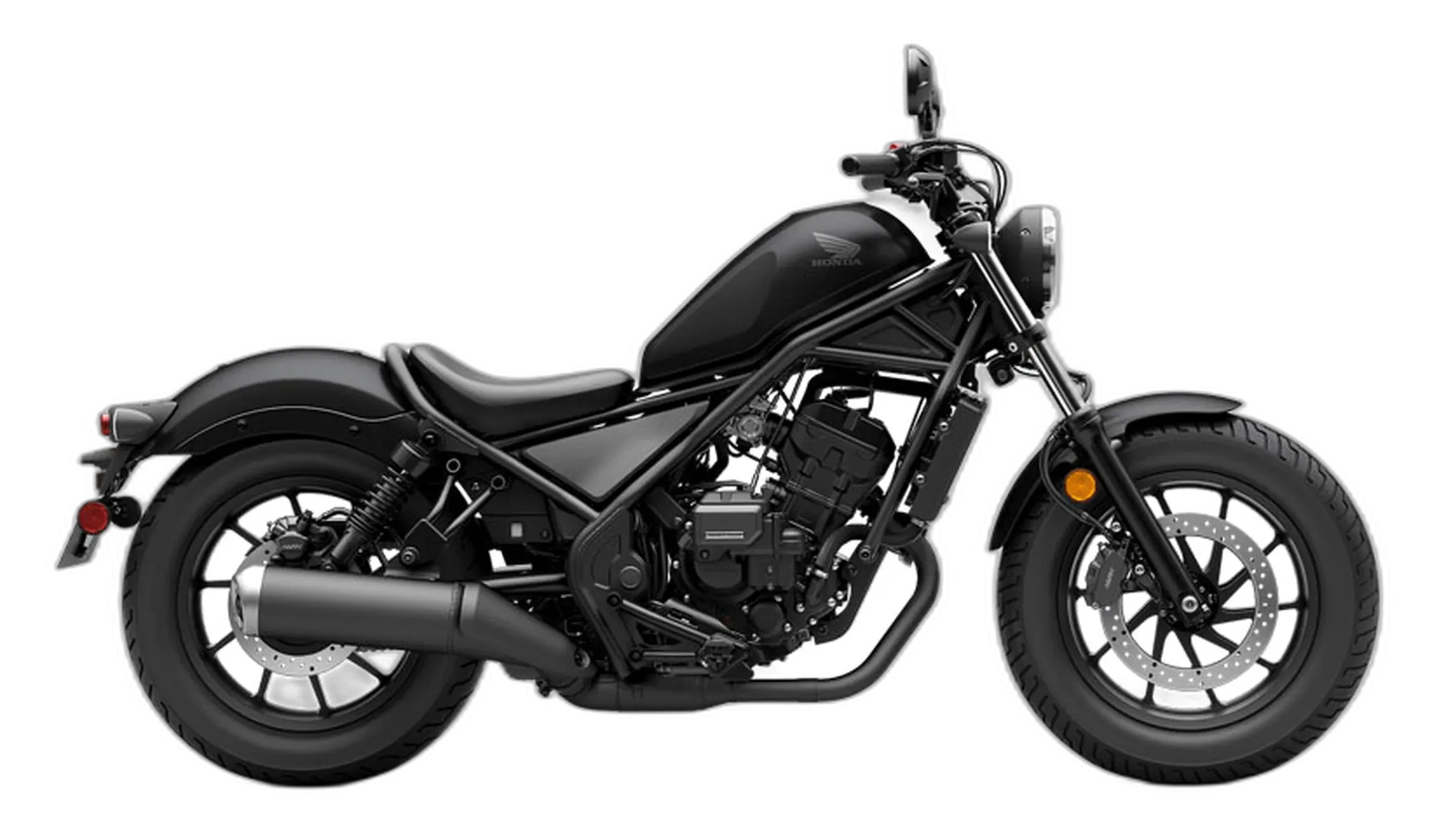

Honda Rebel 300 (CMX300-E_Clutch) — Cruiser
Honda press archive

2026 · Cruiser · A variant of the Rebel 300

Rebel 300 E-Clutch (CMX300-E_Clutch)

Differences between the standard Rebel 300 and the E-Clutch

3.5 / 5 NastyNils Rating · against its class

The Low-Slung Confidence Builder

The Machine's Character

The Rebel 300 keeps the cruiser formula honest: a 27.2 in (690 mm) seat, a 58.7 in (1,490 mm) wheelbase, fat 16-inch tires at both ends and a steel diamond frame wrapped around a 286 cc liquid-cooled single. What defines this version is Honda E-Clutch. Honda says it lets you shift without using the clutch lever, simplifying the learning curve and reducing fatigue, and the lever is still there when you want it. ABS, a slipper clutch and an LED headlight all come standard. At 379 lb (172 kg) wet, that's a lot of help packed into a light cruiser. Small bike, serious kit.

On paper, this hardware is built for the rider who's still finding their feet, or the one who simply wants a cruiser without the heft. Its 28 hp at 8,500 rpm and 20 lb-ft at 6,000 rpm are sized for town, back roads and the run out to the weekend meet-up, and the 3.0 gal (11.2 L) tank fits that radius. Low running costs and strong reliability point the same way: a bike built to be bought, ridden and kept. The long, low stance gives you real chopper style, and it's a good base for the aftermarket. Simple suspension, nothing to fiddle with. That's Honda logic.

Hard Numbers

Spec sheets don't ride bikes, but they set the baseline.

Show full specs & equipment Hide specs & equipment
Key specifications
Power 28 hp (21 kW) @ 8,500 rpm
Torque 20 lb-ft (27 Nm) @ 6,000 rpm
Displacement 286 cc
Engine Single-cylinder
Cooling Liquid-cooled
Gearbox 6-speed
Final drive Chain
Fork Telescopic
Front brake 296 mm
Front tire 130/90-16
Rear tire 150/80-16
Wheelbase 58.7 in (1490 mm)
Seat height 27.2 in (690 mm)
Wet weight 379 lb (172 kg)
Fuel capacity 3.0 gal (11.2 L)

Equipment check

Comfort

  • Luggage System Optional

Lighting

  • LED Headlight Standard

Safety

  • ABS Standard

Signature Tech

The named systems that set this bike apart — and what each one does for you.

Drivetrain

  • Honda E-Clutch Standard
    • Clutchless riding
    • Stall free low speed
    • Seamless power shifts
    • Full throttle upshift

What the Rebel 300 E-Clutch Adds — Differences vs the Standard Rebel 300

The Rebel 300 E-Clutch (CMX300-E_Clutch) builds on the standard Rebel 300: the upgraded hardware, the key spec changes and where its character shifts. The full ride, specs, scoring and verdict are all right here on this page.

Equipment the E-Clutch adds vs the standard Rebel 300

Added
Slipper Clutch
Now standard
ABS

Premium hardware the E-Clutch brings

  • Transmission Quickshifter Down An up-and-down quickshifter for clutchless downshifts; the standard blips on upshifts only.
  • Transmission Quickshifter Up A quickshifter for clutchless upshifts the standard goes without.

Hard spec differences

SpecStandard Rebel 300E-ClutchΔ
Power 27 hp 28 hp +1 hp
Wet weight 364 lb 379 lb +15 lb
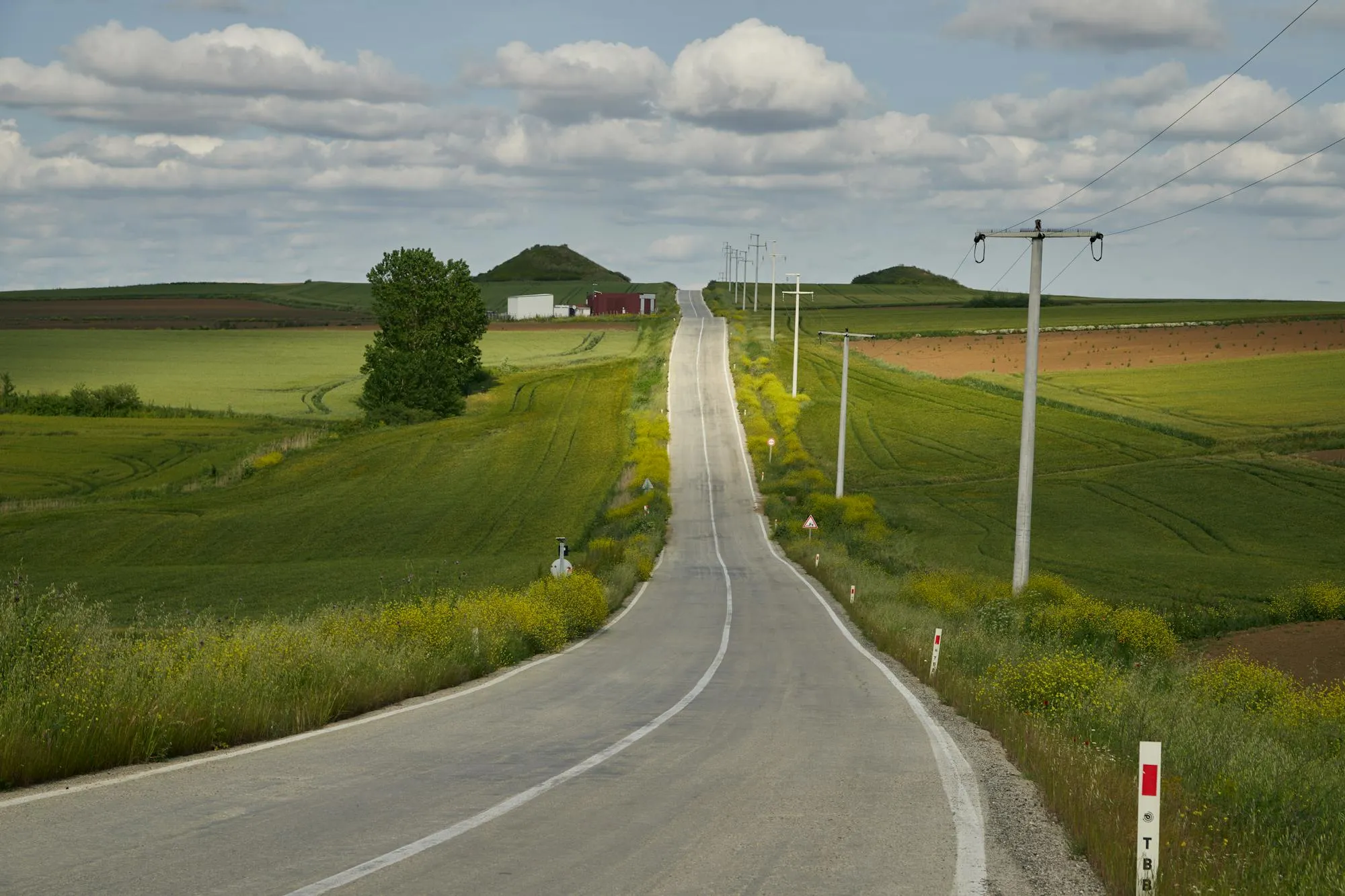
A long, straight paved road stretches toward the horizon through agricultural fields in Vermont. Power lines and a mailbox are visible along the roadside. Lush green vegetation, cumulus clouds, good daylight conditions. The landscape is flat to gently rolling. Asphalt pavement appears to be in good condition. Rural American setting.
Meric Tuna / Pexels

The Truth on the Street

I've been listening to Rebel owners for years: in the paddock, at club nights, in parking-lot chats, and in the emails and messages riders send me once they've put real miles on their bikes. On the Rebel 300 the pattern is clear. Owners love how easy it is to live with. Their complaints come up out on the highway, on longer stints in the saddle and when they push the suspension.

Light, low and easy to trust

The praise I hear most is about how manageable this bike is. New riders and owners with shorter inseams consistently say the low seat and light weight take the fear out of it, and riders across a wide range of inseams describe the upright position as unintimidating. Owners say it threads through tight city traffic with ease and that their confidence builds fast. They also give the relaxed position credit on short commutes and longer outings alike. The E-Clutch has its own fans: riders describe smooth pull-aways from a stop and rev-matched downshifts that feel seamless. Many owners add that the stock bike already looks custom, and they enjoy personalizing it with Honda genuine accessories. Some also mention a peppy single for city riding and strong mpg. Easy to live with.

Where the highway catches up

The most consistent gripe is about the open road. Owners agree the Rebel 300 can hold highway speeds, but they say it feels strained up there and runs out of steam. It also leaves little in reserve for passing. Many owners also mention having to downshift often to keep it pulling at higher speeds. Passing takes patience.

A firm seat and soft springs

The saddle is the other thing owners complain about again and again. They describe it as thin and firm with little support, and many say it starts to hurt after about an hour. Some riders also report that the soft fork and shocks, which they like over bumps, start to wallow when you push hard in corners. The pegs touch down early, and the chassis loses its composure. Plush until you push.

Known issues

  • E-Clutch may stop working prematurely

    drivetrain rare

    Some owners report the E-Clutch system ceasing to function prematurely at low mileage. The system defaults to manual clutch operation, but the electronic clutch mode becomes unusable.

  • Crankcase breather oil buildup causing sluggish acceleration

    engine occasional

    Some owners reported that oil accumulated in the airbox from the crankcase breather, leading to hesitations and sluggish low-speed response.

  • Honda accessory tank pads peeling

    bodywork occasional

    The adhesive-backed accessory tank pads can lift or peel from the fuel tank in hot weather.

The Expert Benchmark

Where this Honda Rebel 300 pulls ahead of — or falls behind — its rivals on the numbers, and the typical bike in its class on character.

What kind of bike this is — character vs. the class

This bike Class average

The shape of the Honda Rebel 300 — numbers and character vs. the average Cruiser

Head-to-head: Honda Rebel 300 vs. its rivals

The 'Should I Buy It?' Score

Forget spec-sheet bragging. Here's who the Rebel 300 is actually built for.

Aerial view of a winding asphalt road cutting through volcanic terrain on La Gomera, Canary Islands. The road curves through sparse green vegetation with rocky volcanic peaks visible in the background and a settled valley to the left. Clear lane markings, dry climate, partly cloudy sky.

Best cruiser for Sturgis?

Best fit of the three: the Rebel 300 gives you genuine low-slung cruiser style for the ride to the rally. It's a 286 cc single, though, so think easy entry ticket, not big-inch statement.

Made for Black Hills / Sturgis Rally Hub · A1A — Florida Atlantic Coast · Daytona Main Street / Bike Week
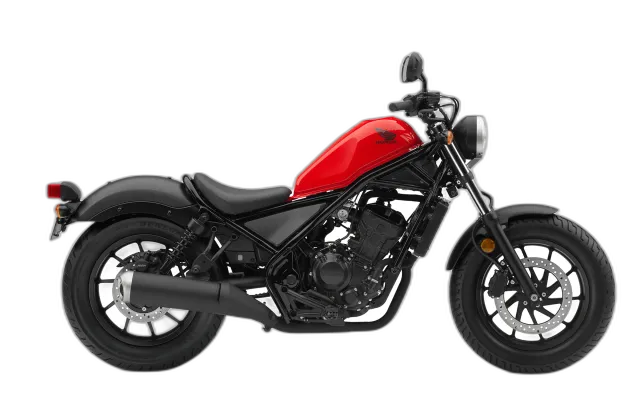
Best retro motorcycle for road trips?

A solid match for unhurried days on historic routes and small-town roads: the Rebel 300 has the classic stance, and its light, easygoing nature suits that calm rhythm.

Made for Acadia National Park · Austin / Handbuilt Motorcycle Show · Blue Ridge Parkway

Best touring motorcycle for long distance?

A partial fit at best. Two-up, fully loaded cross-country touring asks more than 28 hp and a 3.0 gal (11.2 L) tank are built for. This one's a short-haul companion.

Made for Beartooth Highway · Blue Ridge Parkway · Going-to-the-Sun Road

What's new versus the previous generation

If you're cross-shopping the older generation, here's what changed.

Honda Rebel 300 (CMX300)

Previous generation · 2017

Honda Rebel 300 (CMX300)

Big Look, Tiny Footprint

Compare to the previous model →