
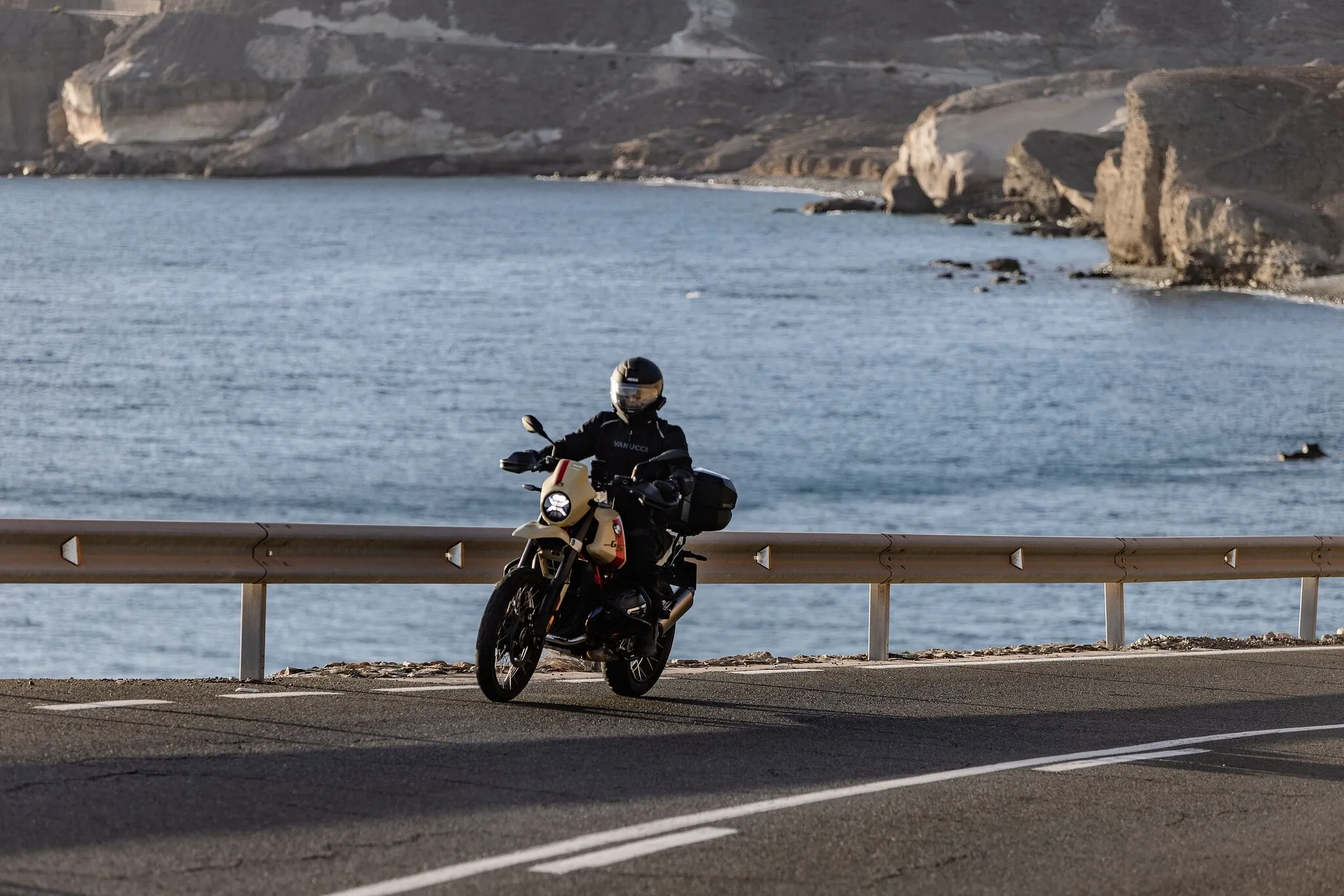
The scrambler category is full of liars.
Not clumsy liars. Technically sophisticated, beautifully executed, professionally photographed liars. The kind that charge premium prices for the lie, and collect thousands of satisfied buyers who never realize what they actually purchased.
Here is the cheat code: one number. One specification, buried in the technical data sheet, that separates a real scrambler from a naked bike wearing costume jewelry. Everything else — the high-mounted exhaust, the wire-spoke wheels, the knobby tires, the brushed-metal tank finish, the desert photography in the brochure — is decoration.
That number is suspension travel.
The Three-Glance Rule
Before we reach the number, a brief introduction to how to evaluate a scrambler visually. This is called the three-glance rule.
Glance one, from distance. The bike should look right from twenty meters. Proportions, stance, color, the relationship between the wheel size and the frame. A real scrambler has a purpose-built visual presence. If the first glance produces a feeling of rightness — that this machine was designed as a coherent concept rather than assembled from a parts bin — you are in the right territory.
Glance two, from near. Look at the details. Welds, surface treatment, the quality of the components. A premium scrambler commands a premium price partly because of genuine material investment. If the finish quality does not match the asking price, that is information.
Glance three, from the saddle. Sit on it. Look down at the machine between your hands. Does it feel like a motorcycle built with conviction, or does it feel like a motorcycle that became a scrambler in the marketing department?
If all three glances produce confidence, the machine passes aesthetics. Then you check the number.
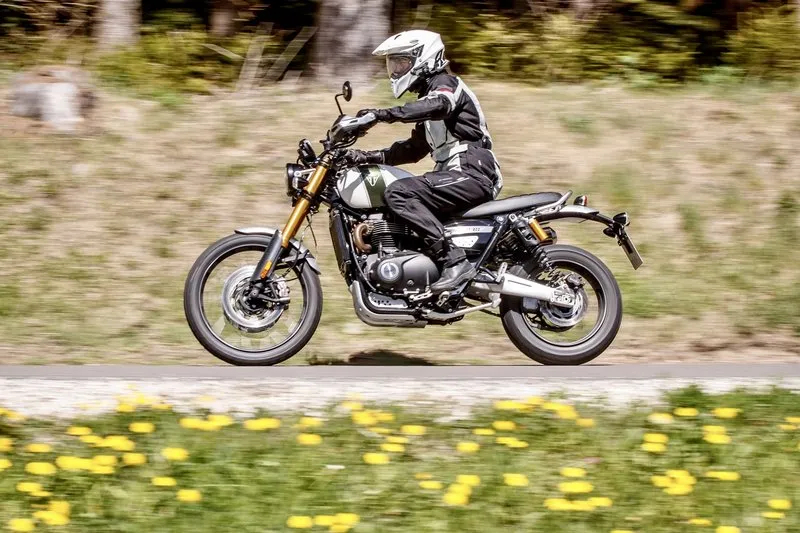
The Suspension Travel Test
A genuine scrambler must deliver meaningful off-road capability. It exists as a category distinct from the naked bike precisely because it promises more than street performance — it promises the mechanical hardware to handle terrain that would stop a standard road bike.
The mechanical hardware required for real off-road capability is suspension travel. Enough stroke to absorb the compression loads of rough surfaces, loose gravel, ruts, and the constant small impacts of riding on imperfect terrain at speed.
The minimum requirement for a genuine scrambler is 6 inches of suspension travel, front and rear.
The range of a real scrambler sits between 6 and 8 inches. In some exceptional cases, travel extends beyond 8 inches — territory where the machine crosses into genuine enduro capability.
Below 6 inches of suspension travel, the scrambler classification is fraudulent.
Most naked bikes — the machines from which many scramblers are directly derived — have between 4.3 and 5.5 inches of travel. They are designed for paved roads, optimized for pavement dynamics, and suspension-tuned for asphalt behavior.
When a manufacturer takes a naked bike donor, raises the suspension slightly, fits knobby tires and high pipes, adjusts the aesthetics toward a trail-ready appearance, and sells it as a scrambler — but leaves the suspension travel at around 4.7 inches — they have produced an optical illusion. A machine with the appearance of off-road capability and the actual mechanical capability of the road bike it was built on.
Spec-Check Module: Real vs. Fake
| Specification | Real Scrambler | Optical Illusion |
|---|---|---|
| Suspension travel | 6–8 inches (150–200 mm) | 4.3–5.5 inches (street spec) |
| Ground clearance | Meaningfully higher than street donor | Identical to the street bike |
| Wheel type | Spoked / dual-sport profile | Cast / street-biased “look” |
| Ergonomics | Optimized for standing / wide bars | Cramped street-bike geometry |
| Braking system | Off-road ABS modes available | Pavement-only ABS, no off-road map |
| Result | Genuine off-road capability | A street bike in a costume |
The Optical Tuning Warning
When a scrambler’s suspension travel is identical to its naked bike sibling, the correct description is optical tuning.
Optical tuning means the manufacturer modified the visual identity of the motorcycle without modifying the functional engineering. You receive the aesthetic. You do not receive the capability. The knobby tire may be real rubber. But at around 4.7 inches of suspension travel, that tire cannot generate useful traction on loose or broken terrain at any speed where the limits of the suspension become relevant. The first serious rut, the first rocky descent, the first gravel road taken at more than walking pace — the motorcycle tells you what it actually is.
This is not a safety lecture. Plenty of riders have no intention of riding their scrambler off-road. If the aesthetic is the product, and the buyer knows this, the transaction is honest. The problem arises when the category name implies capability that the machine does not have — and when riders choose a scrambler over a naked bike, paying a premium for off-road promise that was never actually engineered in.
What to Actually Check at the Dealer
Stand in front of the technical specification sheet. Not the marketing brochure. The technical specifications.
Find the suspension travel figure. Both front and rear.
If both numbers are at or above 6 inches, the machine has the foundational hardware for real scrambler use. Then evaluate quality of components, geometry, and whether the overall package is engineered for purpose or engineered for appearance.
If either number is below 6 inches — particularly if it matches the suspension travel of the naked bike platform the scrambler is built on — ask yourself what you are actually buying.
A very nice-looking street bike. With better sounds from that high pipe. And a style you may genuinely prefer.
That is a legitimate choice. But it is not a scrambler.
The marketing department calls it a scrambler.
The suspension specs tell you what it is.