
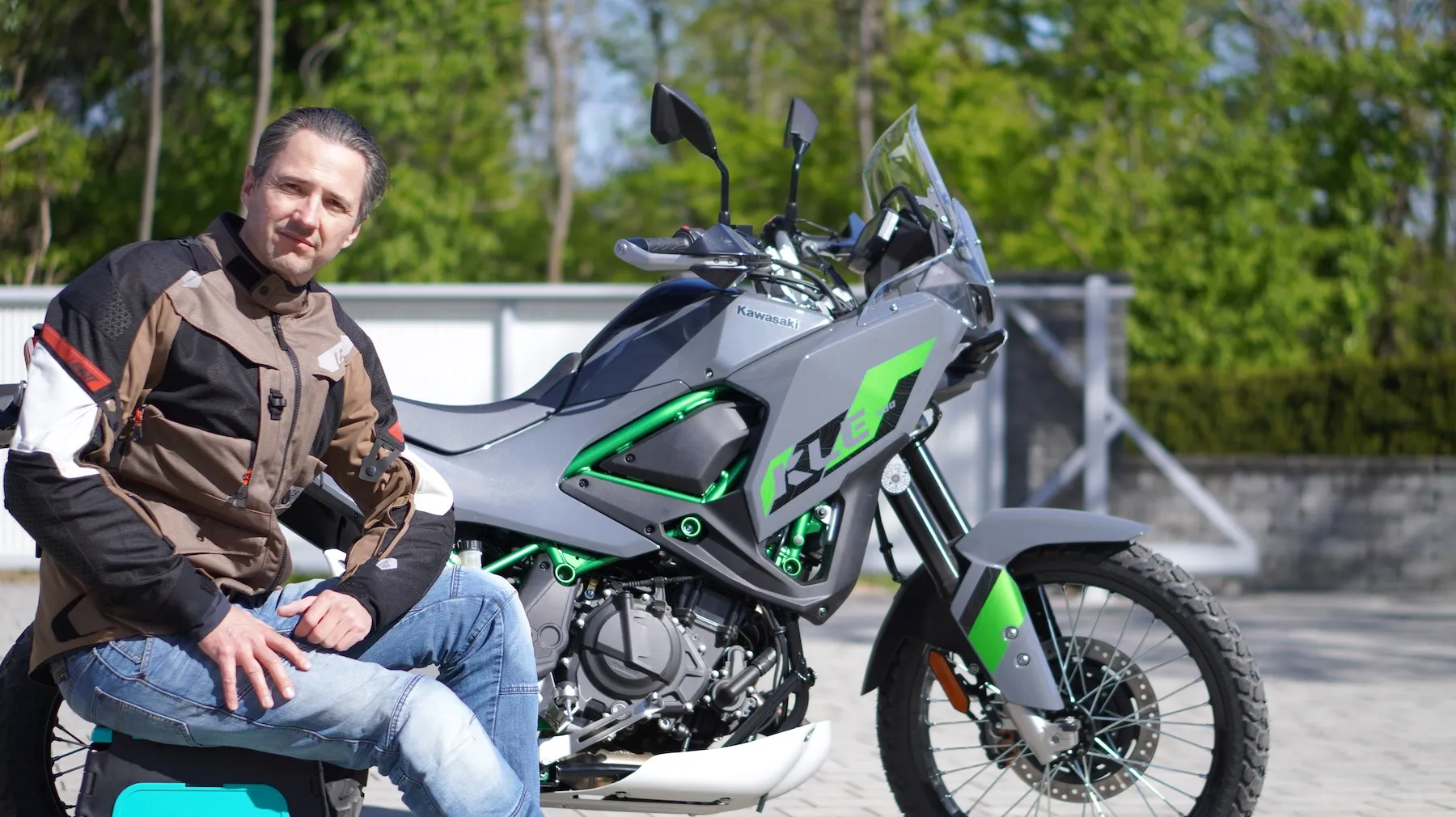
Quickshifter !
- Motorcycling is built entirely on trust. If you are physically afraid of your bike at a standstill, that fear will follow you everywhere — into hairpins, roundabouts, fuel stops, and every sloped gravel lot you will ever encounter.
- The wrong combination of seat height and weight is the most common purchasing error in motorcycling. It is also the most silent one, because nobody talks about it at the dealer.
- Sizing down is not failure. It is the precise calculation that buys you joy. A lighter, lower bike ridden with confidence is worth a hundred over-spec’d machines ridden in tension.
Picture a sloped gravel parking lot.
Not a nice flat one. A sloped one. Slightly off-camber. A bit of loose grit over packed dirt. Maybe some wet leaves in the corner. The kind of lot that exists outside approximately every mountain roadside restaurant that you will ever want to stop at on a riding trip.
Now picture arriving there on a motorcycle that makes your stomach tighten before you even come to a stop. The bike is tall. It is heavy. You know that if you misjudge the foot placement by six inches — if the slope is slightly steeper than it looks, if the gravel gives a little more than expected — there is a strong chance the machine is going down. You are committed to the stop. And between the moment you pull off the road and the moment you find solid footing, you are managing pure, physical fear.
That fear is real. And it is the exact feeling that kills the joy of riding for a significant percentage of the people who leave dealerships with too much machine for their body type, their experience level, or both.
The Mental Parking Lot Test
There is a simple diagnostic you can run before you buy any motorcycle — or before you keep the one you have. No road required. No dealer present.
Close your eyes. Place yourself on the motorcycle. Mentally ride it to the most uncomfortable scenario you can construct. Not a canyon road at full lean — something slower and more specific. A tight U-turn in a busy intersection with cars waiting. A parallel parking maneuver in front of a café with your riding group watching. The sloped gravel lot from the paragraph above.
Feel your reaction.
If your gut tightens in that mental image — if the scenario produces something that is clearly stress and not pleasurable challenge — you have found your answer. The motorcycle is not fitting your trust level. Not today. Maybe not yet. Maybe not ever, depending on the gap.
This test is not about skill or courage. It is about the fundamental requirement of motorcycling: the machine and the rider must be in a working relationship. Not a strained one. Not a fearful one. A functional one where both parties agree on what is happening.
A motorcycle that frightens you at zero miles per hour has already failed the only test that matters.
The Ego Trap
Here is what makes this hard to discuss.
The motorcycle market does not encourage downsizing. Manufacturers spend considerable resources projecting aspiration — the idea that bigger, heavier, more powerful machines represent progress, achievement, and arrival at a correct destination. The premium category is always taller, always heavier, always with more cylinders. The marketing narrative positions these machines as rewards for experience rather than tools that may or may not fit a specific person’s body and intended use.
So a rider who genuinely needs a lower, lighter machine to ride with confidence is often fighting an invisible pressure to choose something more impressive on paper. Choosing a fully-loaded adventure machine that tips the scales near 850 lbs because the catalog says it is what passionate riders ride, when you are 5’6” and 155 lbs and have not yet fully developed your low-speed maneuvering skills, is choosing the catalog over your own nervous system.
And the nervous system always wins. Not elegantly. It wins through locked elbows, white-knuckle fuel stops, avoided routes, and sessions that end with relief rather than satisfaction. The adrenaline from a near-tip at a standstill is not the good kind. Accumulated over a season, it erodes the motivation to ride.
For larger riders — taller, heavier, physically stronger — this calculus shifts. A 550-lb adventure bike presents no weight-related confidence problem for someone who is 6’3” and 210 lbs. That person may genuinely benefit from more displacement and a higher seat. The point is not to discourage big motorcycles. The point is that physical fit matters more than anything in the spec sheet.
Trust Is Mechanical, Not Philosophical
The mental parking lot test is not about parking. It is about measuring trust.
Motorcycling is entirely trust-based. This sounds philosophical but it is mechanical. When a rider trusts their machine — feels certain that their feet will reach the ground, that the weight is manageable in any situation they can reasonably anticipate, that a brief loss of balance will not result in a crash — the entire upper body relaxes. The elbows bend. The hands lighten on the bars. The steering becomes responsive because the steering is no longer being corrupted by grip tension from a rider bracing against their own anxiety.
When a rider does not trust their machine — when they are managing fear at low speed, when parking produces more stress than the riding itself — the upper body locks. Arms stiffen. Hands tighten. The bars receive constant, conflicting input. The motorcycle becomes genuinely harder to control because the control interface is jammed with tension.
Fear at 0 mph does not stay at 0 mph. It comes with you into every corner.
Sizing Down Without Shame
The most liberating decision many riders make is choosing a smaller motorcycle.
Not downgrading. Not settling. Choosing correctly.
A motorcycle that is 90 lbs lighter than the one that made you tense will offer you more of everything you actually want from riding: precision at low speed, confidence in traffic, ease of maneuvering, and freedom from the background anxiety that contaminates every ride on a machine that does not physically match your body.
Modern manufacturers have largely recognized this. The feature gap between entry-level and premium models has narrowed dramatically in the last decade. Anti-hopping clutches, traction control, cornering ABS, and electronically managed engine braking now appear in model segments that cost less and weigh less than the flagships. The argument that you must buy the biggest machine to access capable technology no longer holds the way it once did.
Riding a light, manageable machine well is objectively better riding than struggling with a heavy machine anxiously. Better lines. Better timing. Better decisions under pressure.
Data Module: 21-Inch vs. 17-Inch Front Wheels
The front wheel size debate is central to the adventure and off-road segment, but the dynamic implications apply broadly enough to matter to any rider choosing between categories.
| Parameter | 21-Inch Front Wheel | 17-Inch Front Wheel |
|---|---|---|
| Primary strength | Rolls over surface irregularities, ruts, and obstacles | Precision cornering on sealed surfaces |
| Handling character | Stable at highway speed, slower turn-in | Quick steering, responsive to input |
| Off-road capability | Genuine; designed for loose surfaces | Limited; essentially a street tire profile |
| Confidence profile | High at speed on rough terrain; can feel large for small riders | Immediately accessible; feels connected on tarmac |
| Category indicator | True adventure / enduro | Sport tourer or crossover |
| Benchmark question | Will I actually ride this off-road? | Am I honest about what I do? |
The 17-inch front wheel on a tall, heavy adventure-styled motorcycle is a reliable signal that the manufacturer designed the machine for tarmac touring and gave it adventure aesthetics. That is a valid choice for many riders. But it matters that you choose it consciously, not because the catalog photos showed it crossing a riverbed.
The 21-inch front wheel demands an honest answer to the question: do you actually ride off-road? A true 21-inch front paired with 8 inches of suspension travel is a genuine off-road tool. It will feel unfamiliar on fast paved roads. That is the trade-off, and it is intentional.
What you want to avoid is choosing either option based on image. Both wheels are legitimate. Neither is universally better. The question is which one matches the roads you actually ride, the body you actually have, and the confidence you actually need.
The Only Metric That Matters
At the end of any motorcycle selection process, there is one question that supersedes the spec sheet, the comparison test scores, the forum opinions, and the manufacturer literature.
Does this motorcycle make me want to ride it?
Not want to own it. Not want to be seen with it. Not want to tell people about it. Want to actually get on it, start it, and go somewhere.
If a lighter, shorter, apparently less impressive machine produces that feeling and the flagship does not — that is not a compromise. That is the correct decision. The motorcycle that gets ridden is always superior to the one that stays in the garage because every stop feels like a structural engineering problem.
The mental parking lot test is free. It takes thirty seconds. And it will save you more money, and more joy, than any number of test rides on machines chosen for the wrong reasons.