
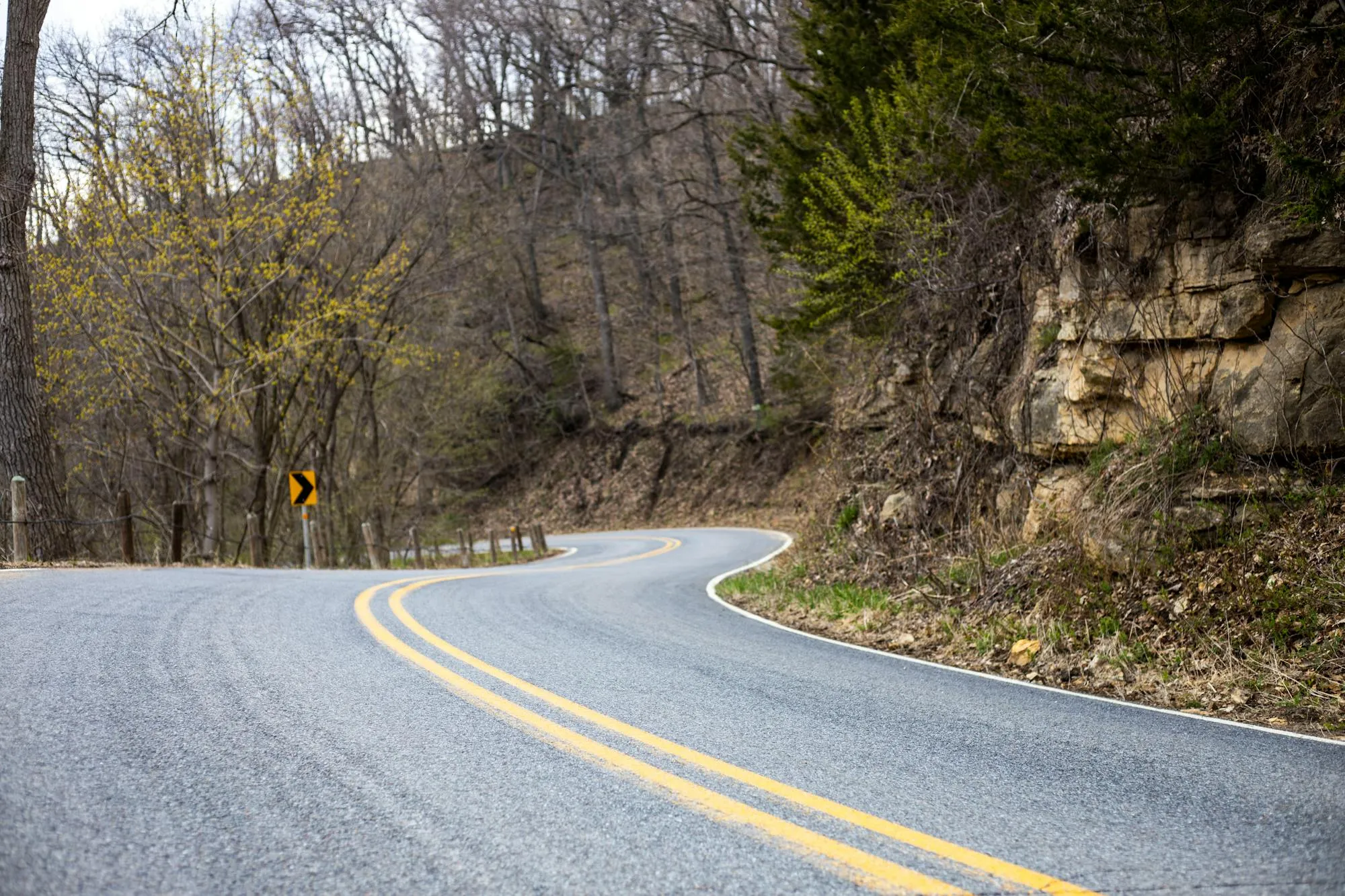
Quickshifter !
- The guardrail is not your primary threat in a blind left-hander. The oncoming truck you cannot see yet is.
- Instinct drives you toward the double yellow line to escape the static guardrail — and places your upper body directly in the path of traffic.
- Ride every blind left-hander as though a loaded RV with wide mirrors — or a logging truck or dually pickup not fully in its lane — is already there. Lane Position 3 (the right third of your lane). Every single time.
The guardrail is right there.
You can see it. You can measure it. Your lizard-brain assigns it maximum threat status because it is concrete, visible, and unyielding. So you drift left. Away from the threat you understand. Closer to the double yellow line. Closer to the lane that belongs to someone else entirely.
And right there — in that one reflexive drift — you have done something remarkable. You have traded a static obstacle for a dynamic one. You have moved away from a piece of metal that is not moving and toward oncoming traffic that absolutely is.
That is the centerline trap. It kills riders who are not reckless. It kills riders who think they are being careful.
Your Brain Is Working Against You
The human brain is extraordinarily good at processing visible threats. A guardrail, a cliff edge, a pile of gravel at the roadside — these register immediately, trigger adrenaline, demand correction.
Oncoming vehicles, however, are a different category of problem. Cars have existed for roughly a century. Buses and trucks at highway speeds are an even more recent addition to the threat landscape your nervous system was built to navigate. Your brain has no deeply wired fear response for invisible oncoming traffic around a blind curve. The pattern simply does not exist in the old archives.
So it defaults to what it knows. Avoid the guardrail. Move left.
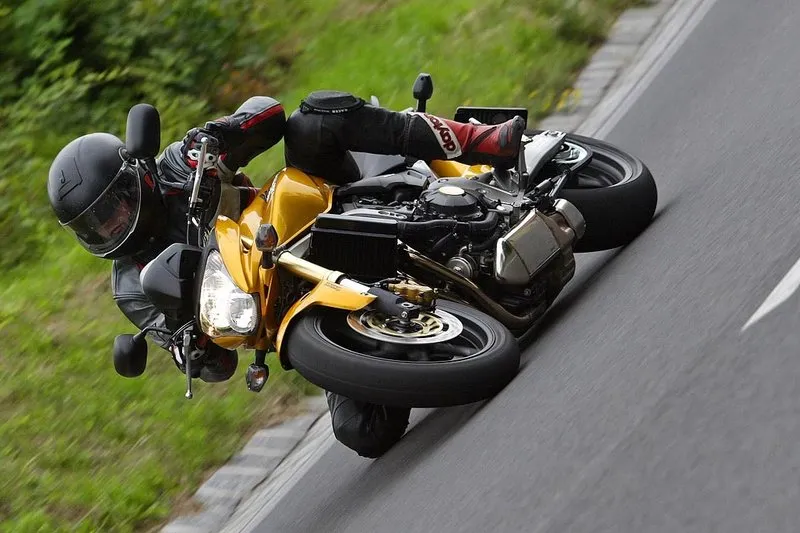
The result: your motorcycle stays technically in your lane. Your upper body — the part attached to your head and containing your brain — is not. Lean angle in a left-hander means your torso extends toward the double yellow line. At typical road speeds, a rider hugging the left edge of their lane in a blind left corner is placing their upper body, and their head, into oncoming territory. Not metaphorically. Physically. By a measurable margin.
A colleague ran video surveillance analysis on a single representative blind left-hander. Over 90 percent of motorcycle riders positioned themselves too close to the double yellow line. This was not a sample of novices or thrill-seekers. These were everyday riders on everyday roads having ordinary days. The pattern was nearly universal.
What the Lane Actually Looks Like
Picture your available road space in a blind left-hander.
You have your lane. Split it mentally into three Lane Positions — the standard nomenclature in US riding schools. Position 1 (left third), Position 2 (center third), Position 3 (right third). Position 1 borders the double yellow line. Position 3 borders the guardrail, the curb, the edge of the world.
Most riders position their motorcycle somewhere in the center or left third. Natural. Instinctive. Spatially wrong.
The correct position is the right third.
Yes. That means closer to the guardrail you are afraid of. Closer to the edge. Tighter. More exposed to the thing you can see.
In exchange, you get three things that matter enormously.
First, your upper body stays well inside your lane. The lean angle that would carry your torso over the double yellow line from Position 1 now keeps it safely inside Position 3. You are no longer physically in oncoming traffic.
Second, you gain sightline. Positioned to the right, you can see further into the curve. The apex arrives later in your visual field, giving you more time to react to anything that appears — gravel, standing water, headlights.
Third, and this is the one people underestimate: space. When you enter from the right, the exit opens up. You have the entire left two-thirds of your lane as a safety buffer at the point where most riders run out of room. You are no longer trapped.
The Invisible Bus Rule
There is a mental model that changes the way you ride blind corners permanently, once it settles in.
Before every blind left-hander, assume the oncoming lane is occupied by the largest vehicle legally permitted on that road. Not probably occupied. Assume it. A fully loaded RV with wide mirrors. A logging truck taking too much road. A dually pickup not fully in its lane. That vehicle exists. It is coming. It will be at the apex of this corner at exactly the same moment you are.
If that bus is real, you have no choice. You ride the right third of your lane. You keep your upper body out of the oncoming lane. You enter wide, pick up your sightline, exit with room.
The bus is almost never there. But occasionally — statistically, over a riding career of any real length — something will be there. A truck taking a wide line. A car drifting. Another motorcycle not following the same rules you are. At that moment, the rider who assumed the bus was real and rode accordingly has a chance. The rider who trusted the gap to be empty is already committed to a line that has no escape.
Riding defensively is not riding slowly. It is riding with spatial awareness sharp enough to act rather than react.
Pro-Tip: The Late Apex Rule
A late apex is not just a racetrack concept. On any blind left-hander, delaying your turn-in point means you enter the corner seeing less of the threat, but you exit it seeing far more of your available road. The late entry pushes your position to the right early, then reveals the full exit as the corner unwraps. You carry your speed into a widening space rather than toward a narrowing one. Combined with the right-third positioning rule, the late apex transforms blind corners from a static anxiety into a dynamic advantage. You are always moving toward more information, not less.
Building the New Habit
The frustrating reality is that the correct position in a blind left-hander feels wrong at first. It feels exposed. The guardrail looks very close. The instinct to drift left reasserts itself constantly at the start.
The mental model that helps: stop looking at the guardrail. Look through the corner, forward and ahead, toward where the road goes after the curve. The guardrail is stationary. It does not require your attention. The exit requires your attention. Direct your eyes there, not at the static edge object your lizard-brain finds so compelling.
With repetition, the right-third entry becomes natural. The sightline improvement is immediately apparent. The exit feels spacious. The corner that previously produced tension begins to feel manageable — not because the road changed, but because your positioning gave your eyes something useful to work with.
The other adjustment is acknowledging lean angle geometry. In a left-hander, your torso extends left. This is not theoretical. Put your hand on your left shoulder when you think about riding a left curve at normal road speed. That shoulder is moving toward the oncoming lane in direct proportion to your lean. Positioning your motorcycle further right compensates for this geometry automatically. The math takes care of itself, but only if you give it the correct starting position.
One More Thing About Sightlines
Riders chronically underestimate how little they can actually see in a given corner.
Most people believe they have reasonably good visibility in curves they ride regularly. Video analysis tends to destroy this assumption. The angle of the corner, the camber of the road, vegetation, barrier walls, the angle of light — all of these shrink the visible window dramatically. A corner that feels familiar and readable is often concealing the last 30 feet before the exit entirely.
Position 3 does not solve limited sightlines. But it shifts the moment you gain visual information forward. A truck appearing in your lane becomes a truck appearing with 160 feet of reaction space instead of 50. The sightline advantage compounds with the position advantage. The corner still has uncertainty baked in. You are simply better positioned to handle that uncertainty.
The guardrail is not moving.
Ride the right third. The bus is always coming.