
Quickshifter !
- Sitting rigidly upright like a statue on a motorcycle is not comfortable — it is passive slumping disguised as good posture. Gravity wins, the spine compresses, and the pain arrives around hour three.
- The correct position is built from the ground up: balls of feet on the footpegs, spine actively lengthened, core engaged. This is called active tension, and it is the difference between a five-hour touring day and a two-hour misery.
- When the core holds the body, the arms release their grip on the handlebars. This is the chain reaction that ends neck pain, forearm fatigue (arm pump), and the compulsive need to stop every hour and a half.
The Myth of the Couch
The touring industry has built a minor economy around the concept that comfort on a motorcycle is primarily a seating problem. Better foam. Gel inserts. Wider platforms. Air systems. Heated elements. These products are not worthless — but they are solutions to a symptom, not the cause.
The cause is passive slumping.
Here is what passive slumping looks like in practice: a rider sits on the motorcycle and allows the body to settle. The weight drops into the seat. The spine rounds slightly at the lumbar. The head projects forward. The arms extend to reach the handlebars and the hands, compensating for the lack of postural support from the core, begin to grip the bar as a structural element — using the handlebar as a spine surrogate. It is the riding-position equivalent of slumping into a recliner.
At low speed or for short distances, this is manageable. The discomfort is mild enough to ignore. But the physics are working continuously. The spine, lacking muscular support, is taking compressive load directly through the discs and joints. The arms, substituting for the core, are being used for the wrong job. The neck, extending forward to keep the eyes level with the horizon, is holding up the weight of a helmet at an unfavorable angle for hours at a stretch.
By hour three, the back aches. By hour four, the arms are pumped. By hour five, you are stopping not because you want to see the view, but because you have to.
The touring seat upgrade does not fix this. Nothing you can sit on fixes this. The problem is what the body is doing on top of whatever you are sitting on.
The Footpeg Foundation
The correct riding position is built from the feet upward.
This is the element most riders skip entirely. They think about bar position, seat height, mirror placement. Almost nobody thinks about how their feet are positioned on the pegs.
The distinction is this: heels down versus balls of feet. US riders also call this “weighting the pegs” — same idea, active versus passive contact.
Riding with the heel on the footpeg is the natural resting position. It is also passive. The leg hangs loosely, the foot finds a stable point, and the body weight settles entirely into the seat. This is comfortable in the sense that it requires no effort — but no effort means no muscular engagement, and no muscular engagement means the spine is bearing load without the muscles doing their job.
Move the contact point to the ball of the foot — the forefoot, just behind the toes — and something changes immediately. The calf engages slightly. The knee bends at a more active angle. The thigh tightens against the tank. The hips shift fractionally forward. The entire lower body becomes a structural participant in the act of riding rather than a pair of legs hanging in space.
This is the footpeg foundation. It is not a subtle refinement. It is the mechanical prerequisite for everything that follows.
When the lower body is actively engaged through the pegs, a small portion of body weight transfers from the seat to the footpegs. Not dramatically. But enough to reduce the compressive load on the lumbar spine measurably over a long day. The pelvis tilts to a more neutral position. The lower back finds its natural curve rather than the rounded slump of passive sitting.
From this point, the rest follows.
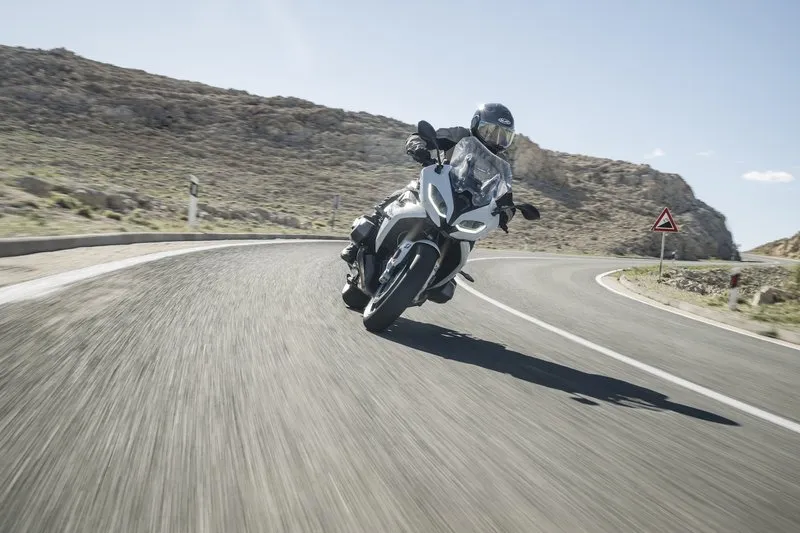
Core Over Arms
The second element of active tension is the spine itself.
Most riders, when asked to improve their posture on a motorcycle, straighten up and hold themselves rigidly vertical. This is better than slumping, briefly, but it is not sustainable. Holding a rigid position through muscular effort without any structural engagement leads to fatigue within minutes. And the moment the rider is distracted by the road, the rigid hold collapses and the slump returns.
The sustainable version is not rigidity. It is active lengthening.
Active lengthening means directing the spine upward — not clenching it into a straight line, but intentionally making the distance between the base of the spine and the crown of the head slightly larger than it would be at rest. This is the same instruction given in yoga, in strength training, in any discipline that requires the spine to bear load without failing.
On a motorcycle, the instruction translates this way: elongate, do not compress. The lumbar should have its natural curve, not a rounded slump and not a forced arch. The thoracic should stack upright over the hips. The head should feel like it floats over the top of the neck, not like it is being held up from the front.
To maintain this position over any meaningful distance, the core musculature needs to be working. Not at high intensity — this is not a plank hold — but at a low, continuous background engagement that keeps the spine from collapsing under gravity and vibration.
This engagement is what makes the arms expendable.
When the core is holding the body, the arms no longer need to. They can hang loosely from the shoulders. The elbows can be slightly bent and relaxed. The hands can maintain light contact with the handlebars rather than gripping them as a structural support. The handlebars go back to doing their actual job, which is transmitting steering input — not holding a rider upright.
The chain reaction of releasing the arms is immediate: wrist pressure decreases, forearm tension drops, shoulder and neck tension follow. The neck, no longer fighting both gravity and arm tension, finds a sustainable neutral position. The rider stops arriving at destinations with a headache.
Technique Breakdown: The Cat Metaphor
The most useful mental model for active riding position is a cat navigating across an uncertain surface. Observe a cat crossing a fence, a narrow ledge, or a terrain change. Its movements are not rigid. They are deliberate, fluid, and dynamically balanced — each paw placement precise, each weight shift controlled. The spine is neither locked nor limp. It is alive.
On a motorcycle, the equivalent is this: when the bike brakes, the upper body moves slightly forward in cooperation with the deceleration force rather than resisting it. When the bike accelerates, it moves slightly rearward. In corners, the outside of the body plants firmer into the peg, the inside releases slightly. None of these movements are large. None of them are effortful. They happen automatically when the body is in an active, engaged baseline state.
A rider passively slumped into the seat has no ability to make these micro-adjustments. The physics simply act on them. The cat-like rider absorbs and redirects forces that the passive rider absorbs and suffers.
Where the Pain Actually Comes From
Back pain on a motorcycle is rarely a hardware problem. It is almost always a software problem.
The disc and joint compression that produces lower back pain on long rides comes from the spine taking load it should be sharing with the musculature. The forearm fatigue (or arm pump, in racing terms) that ruins afternoon rides comes from hands gripping handlebars that the core should be holding the body away from. The neck pain that settles in around 250 miles comes from a head supported by arm tension and forward projection rather than by a properly aligned spine.
The upgrade path for all of these problems is the same: develop enough core fitness to maintain an active sitting position for the duration of a riding day. This is not a demanding fitness goal. It does not require dedicated gym time or dramatic lifestyle adjustment. A modest, consistent program of core strengthening — planks, dead bugs, hip bridges, whatever the rider finds sustainable — produces noticeable results on the bike within weeks.
The touring industry would prefer you spend the money on a new seat. The actual fix is cheaper and more durable. Active tension costs nothing. It just requires the rider to understand why passive sitting, no matter how it appears from the outside, is not rest. It is the slow accumulation of load in places not built to carry it.
The footpeg foundation. The elongated spine. The released arms.
Build upward from the feet, hold it from the center, and let the hands do only what hands are supposed to do.